Sunday, January 15, 2017

Eight billionaires 'as rich as world's poorest half'

  • 2 hours ago
  •  
  • From the sectionBusiness

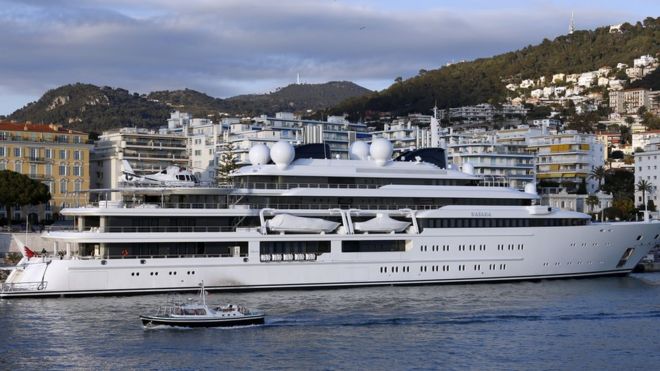
superyachtImage copyrightGETTY IMAGES
Image captionSuperyachts are the calling card of some ultra-wealthy individuals

The world's eight richest individuals have as much wealth as the 3.6bn people who make up the poorest half of the world, according to Oxfam.
The charity said its figures, which critics have queried, came from improved data, and the gap between rich and poor was "far greater than feared".
Oxfam's report coincides with the start of the World Economic Forum in Davos.
Mark Littlewood, of the Institute of Economic Affairs, said Oxfam should focus instead on ways to boost growth.
"As an 'anti-poverty' charity, Oxfam seems to be strangely preoccupied with the rich," said the director-general of the free market think tank.
For those concerned with "eradicating absolute poverty completely", the focus should be on measures that encourage economic growth, he added.
Ben Southwood, head of research at the Adam Smith Institute, said it was not the wealth of the world's rich that mattered, but the welfare of the world's poor, which was improving every year.
"Each year we are misled by Oxfam's wealth statistics. The data is fine - it comes from Credit Suisse - but the interpretation is not."

'Elite gathering'

The annual event in Davos, a Swiss ski resort, attracts many of the world's top political and business leaders.
Katy Wright, Oxfam's head of global external affairs, said the report helped the charity to "challenge the political and economic elites".
"We're under no illusions that Davos is anything other than a talking shop for the world's elite, but we try and use that focus," she added.
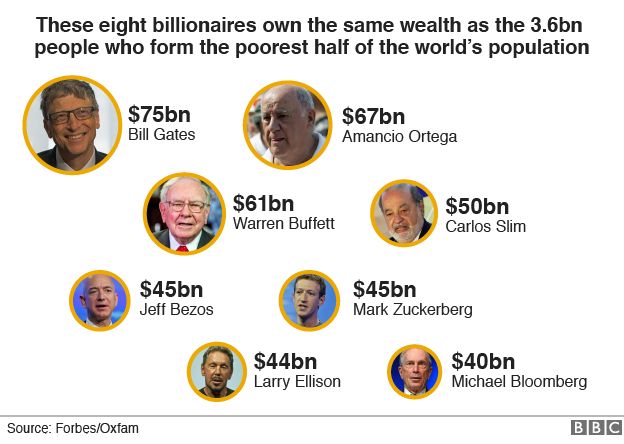

Graphic showing eight richest men

The world's eight richest billionaires

1. Bill Gates (US): co-founder of Microsoft (net worth $75bn)
2. Amancio Ortega (Spain): founder of Zara owner Inditex (net worth $67bn)
3. Warren Buffett (US): largest shareholder in Berkshire Hathaway (net worth $60.8bn)
4. Carlos Slim Helu (Mexico): owner of Grupo Carso (net worth $50bn)
5. Jeff Bezos (US): founder and chief executive of Amazon (net worth $45.2bn)
6. Mark Zuckerberg (US): co-founder and chief executive of Facebook (net worth $44.6bn)
7. Larry Ellison (US): co-founder and chief executive of Oracle (net worth $43.6bn)
8. Michael Bloomberg (US): owner of Bloomberg LP (net worth $40bn)
Source: Forbes billionaires' list, March 2016

UK economist Gerard Lyons said focusing on extreme wealth "does not always give the full picture" and attention should be paid to "making sure the economic cake is getting bigger".
However, he said Oxfam was right to single out companies that it believed fuelled inequality with business models that were "increasingly focused on delivering ever-higher returns to wealthy owners and top executives".
Oxfam's Ms Wright said economic inequality was fuelling a polarisation in politics, citing Donald Trump's election as US president and the Brexit vote as examples.

'Fair share'

"People are angry and calling out for alternatives. They're feeling left behind because however hard they work they can't share in their country's growth," she said.
The charity is calling for "a more human economy" and is urging governments to crack down on executive pay and tax evasion and impose higher taxes on the wealthy.
It also wants business leaders to pay a "fair share of tax" and has urged companies to pay staff the "living wage", which is higher than the government's National Living Wage.
Oxfam has produced similar reports for the past four years. In 2016 it calculated that the richest 62 people in the world had as much wealth as the poorest half of the global population.
The number had fallen to just eight this year because more accurate data was now available, Oxfam said.
It was still the case that the world's richest 1% had as much wealth as the rest of the world combined, Oxfam said.

Mark Zuckerberg and Priscilla ChanImage copyrightGETTY IMAGES
Image captionFacebook co-founder Mark Zuckerberg and wife Priscilla Chan

Some of the eight richest billionaires have given away tens of billions of dollars. In 2000 Bill Gates and his wife Melinda set up a private foundation that has an endowment of more than $44bn.
In 2015 Mark Zuckerberg and his wife Priscilla Chan pledged to give away 99% of their net worth in their lifetimes, which equated to about $45bn based on the value of Facebook shares at the time.
It takes cash and assets worth $71,600 to get into the top 10%, and $744,396 to be in the top 1%.
Oxfam's report is based on data from Forbes and the annual Credit Suisse Global Wealth datebook, which gives the distribution of global wealth going back to 2000.
The survey uses the value of an individual's assets, mainly property and land, minus debts, to determine what he or she "owns". The data excludes wages or income.
The methodology has been criticised as it means that a student with high debts, but with high future earning potential, for example, would be considered poor under the criteria used.

These people are really all criminals stealing wealth they never could have earned by themselves. The capitialist economic system rewards thieves like these who sit as toll gate keepers exacting their private tolls for each commodity that their corporation produces as a collective process in manufacturing, distributing and consuming. Do the rest of the people in this process receive their fair share for their work without which the Super Rich would never exist as such? No, which is why this capitalist system is in reality a con game for a tiny set of world manipulating greedos. It doesn't matter that some of the greedos give away enormous amounts of money when they do Nothing to alter the unfair criminal corporate capitalist system that continues to screw the human race, the whole human species. 

Tuesday, November 29, 2016

Boycott PayPal that discriminates against Palestinians but does business with Israeli settlers

 PayPal's recent IMAGE promotion that hides the real use of a money transfer system being used as a political weapon by Zionists against Palestinians.

PayPal's CEO is ready to break records on Giving Tuesday
Abigail Stevenson |

CNBC.com

 Mad Money 2 PayPal's CEO is ready to break records on Giving Tuesday
13 Hours Ago | 09:08

Ahead of Giving Tuesday, PayPal's CEO Dan Schulman says doing good is a responsibility for all companies.

"We cannot just rely on the public sector or the private sector. We all need to work together," Schulman told Jim Cramer on "Mad Money" on Monday.

Last holiday period, 7.25 million people gave over $850 million to 250,000 charities on PayPal. The company broke every record, Schulman said, as the platform facilitated $48 million in donations within a 24-hour period.

This was up from just $19 million the year before.
http://www.cnbc.com/2016/11/28/paypals-ceo-is-ready-to-break-records-on-giving-tuesday.html

What PayPal's CEO Dan Schulman isn't telling Americans and the world


PayPal and Palestine

AUGUST 27, 2016, BY SAM BAHOUR

PAY_PAL

As a Palestinian-American management consultant in Ramallah, Palestine, I advise my Palestinian clients living under Israeli military occupation to use world-class software and online services, assuring them that it will help them enter global markets.  Some of these clients are not-for-profit outfits, like the Palestinian Circus School and Birzeit University; others are tech start-ups, many of which are funded by U.S. tax dollars via USAID.  Time and again, I regretfully must explain to clients that the most popular worldwide online payment system, PayPal, is unavailable to them.

As an American from Youngstown, Ohio, trying to contribute to building a modern Palestinian economy, and a former software developer who worked all over the U.S., I can never offer a satisfactory answer to those who ask why PayPal refuses to follow the lead of technology giants like Google, Cisco, HP, Oracle, and many others, that all operate in Palestine.

Palestine has a thriving banking sector and all Palestinian banks have corresponding U.S. banks that make money transfers daily.  The U.S. Treasury Department is also active in Palestine and has praised the level of Palestinian banking compliance.  Considering these financial ties, it is a mystery why PayPal, which is widely considered the most trustworthy company in its sphere, continues to ignores this market.  While it’s available to users in Israel and to Israeli settlers living illegally on occupied Palestinian land, PayPal does not extend its services to Palestinians living in the West Bank and Gaza.

Many of these illegal Israeli settlers live literally a few minutes walk from my home, yet they have access to PayPal, but Palestinians do not.  This is doubly unfortunate since Palestinians who live in other parts of the world and are regular users of PayPal cannot use the platform to conduct business with Palestinians who live in the West Bank and Gaza.

Israel has continuously placed suffocating limitations on the Palestinian economy, many which have been directly challenged by successive U.S. presidents, such as Israel’s refusal to release the needed frequencies for Palestinians to have 3G services.  The Internet age has brought with it a bit of relief from these physical limitations, and the Palestinian tech sector is a key area of the economy that has potential to grow, especially considering the population is so young.  Palestine produces roughly 2,000 IT graduates per year that are well-positioned to address the huge gap between growing demand for online Arabic content and the current lack of supply.  Currently, however, only one-third of these graduates find work in their field.  Without access to the needed services that facilitate businesses to grow, more Palestinian youth will fall into the despair of unemployment and all that it carries with it.

In order to meet these market needs and generate employment opportunities, Palestinian startups and entrepreneurs need equal access to services like PayPal for business and charitable services. In December, the President of Americans for a Vibrant Palestinian Economy (AVPE), Edward Thompson, and myself, as Chairman of AVPE, wrote to inform PayPal CEO Daniel Schulman of the company’s shortcomings in Palestine, but our request for a meeting went unheeded.  Now, a group of 40 prominent Palestinian organizations have penned a public letter asking Mr. Schulman to reconsider.

Among the signatories are the Palestinian Telecommunications Group (Paltel) the largest private-sector company in Palestine and one that I assisted in establishing, the renowned startup incubator Gaza Sky Geeks, and Palestine’s National Beverage Company, whose CEO Zahi Khouri is an early stage startup investor through another signatory, the Ibtikar Fund.  And these are just a few examples — those in tech, business and finance have come together from across the span of the struggling Palestinian economy to make this request.  Seemingly small but poignant indignities like this one block the road toward freedom, justice and equality for Palestinians, and we hope to methodically clear them from our path.

In the letter, my co-signers and I explain that while other payment portals are available, there is no replacement for the trust and familiarity that PayPal inspires among potential users, particularly those that are unfamiliar with Palestine-based companies.  Without access to PayPal, Palestinian entrepreneurs, nonprofits, and others face routine difficulties in receiving payments for business and charitable purposes.

Perhaps the most disturbing thing about PayPal’s presence in Israel-Palestine, however, is that access to it depends on ethnicity.  Again, while Israeli settlers living in the West Bank are completely integrated into the Israeli system and have access to PayPal and other technologies, the Palestinians they live among do not.  These are settlements that are considered illegal under U.S. foreign policy and international law, and the settlers who live in them enjoy access to resources that are regularly denied to the Palestinians next door.  In fact, Human Rights Watch released a report earlier this year stated that businesses should withdraw from the settlements entirely to end their complicity in “an inherently unlawful and abusive system that violates the rights of Palestinians.”

This is not just about access to PayPal.  It is about PayPal’s role in empowering entrepreneurs, small businesses, and individuals to make a living and conduct commerce, particularly in parts of the world where physical barriers and limitations are established by governments.  We would be doing ourselves, as Americans and Palestinians, a disservice by allowing any company to deny their service based on ethnicity, heritage or because of Israeli pressure to enforce a clear suppression of the Palestinian economy via the limitations of occupation.

It is our sincere hope that our latest attempt to right this wrong will not fall on deaf ears.  For the Palestinian people, breaking free from Israeli military occupation will mean carving out a meaningful space for ourselves in the global economy, and we cannot do that without equal access to indispensable tools like PayPal.

 This essay originally appeared on August 26, 2016 on ePalestine, a website featuring commentary by Sam Bahour.  It was reproduced here with the consent of Mr. Bahour.

Sunday, September 25, 2016

New report confirms grim outlook for elephants


  • From the sectioncie
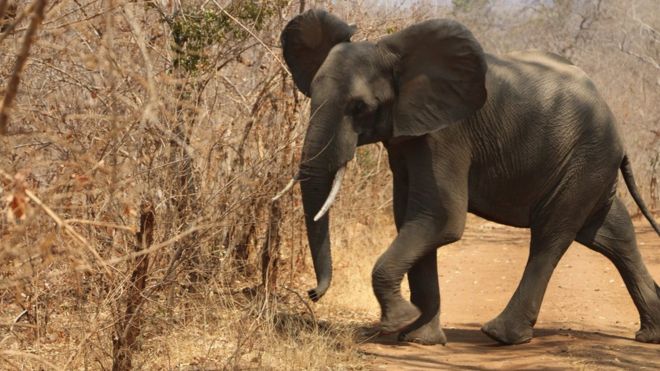
Elephant (file image)
Image captionThe illegal trade in ivory has seen elephant numbers plummet
Elephant populations in Africa have declined by around 111,000 over the past 10 years according to a new study.
The African Elephant Status report says that poaching is the main driver of the fall, the worst losses in 25 years.
However the authors say that long-term issues such as the loss of habitat also pose a significant threat.
The report has been presented at the Cites meeting which is considering new proposals on elephant protection.

War on elephants - Alastair Leithead, Africa correspondent

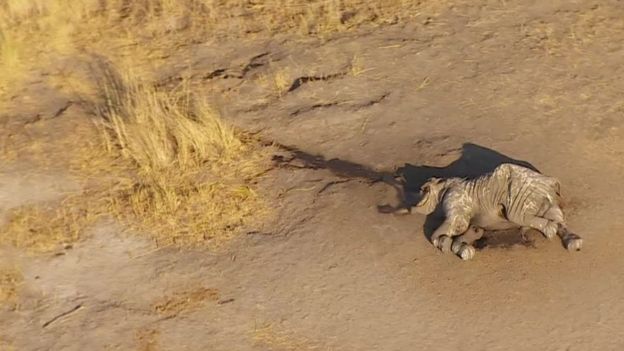
A dead elephant
Image captionThe growing demand for ivory in Asian markets means the illegal trade continues to threaten the future of elephants in Africa
  • Every year in Africa between 30,000 and 40,000 elephants are poached for their ivory, and it's thought there are only 400,000 left.
  • Even accounting for the newborns, this rate of killing calls into question whether these amazing creatures will still be around in a generation, especially as Africa's ever-increasing population is reducing the space for them.
  • Organised crime runs the ivory industry.
Extract from The War on Elephants; article on how the very existence of Africa's elephants is threatened by poachers
More from Alastair:

Wide range of sources

Figures published earlier this year in the Great Elephant Census indicated that African elephant populations had declined by around 30% over the past seven years.
This new study from conservation group IUCN incorporates this information but also uses data from elephant dung counts and individual observations amongst other sources.
The authors say the overall total for elephants in Africa is now around 415,000, although there may be an additional 117,000 to 135,000 in areas not systematically surveyed.
This represents a decline of some 111,000 from the report carried out in 2006.
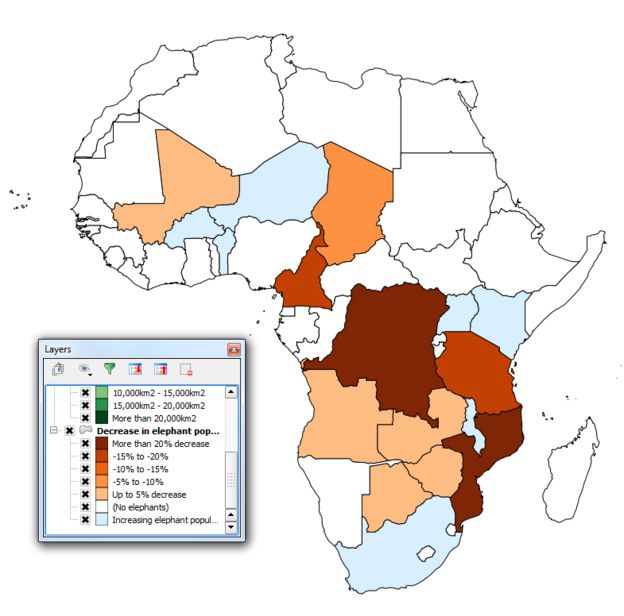
Map
Image captionPercentage change estimates are per year for 2010-2014, so total losses are three or four times the percentages indicated on the graphic
Poaching is the main driver of the drop. East Africa, the region most affected by killings for ivory, has experienced around a 50% reduction in numbers.
However it is not the only cause of concern to the authors.
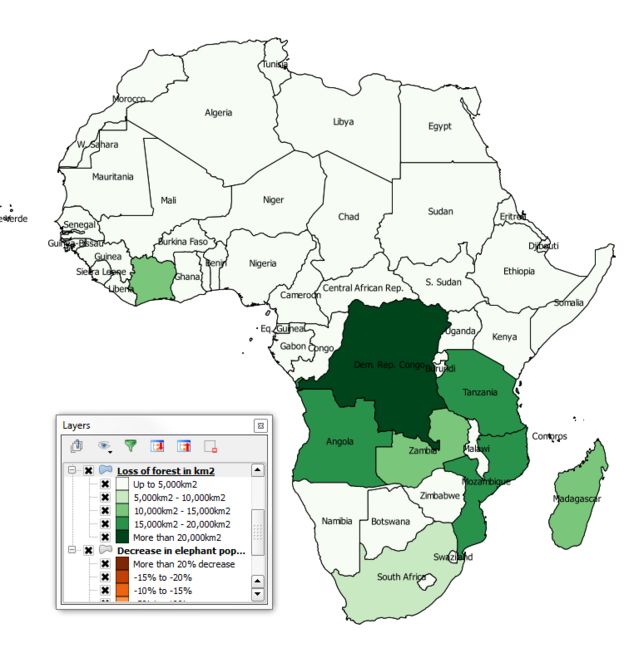
"We are particularly concerned about major infrastructure projects that are cutting up the elephant ranges, this is a particular problem for road development in central and east Africa," said Dr Chris Thouless, one of the report's authors.
"These are all major issues that will have to be dealt with once the poaching crisis is over."

Community conservation

While report highlights the losses there are also some gains.
Elephant populations in South Africa, Namibia and Uganda have all increased. Elephant ranges have expanded in Kenya and Botswana, with community based conservation showing real success in Northern Kenya.
Map
While these are positives, the overall picture is one of dramatic decline, fuelled by criminal activity that would decimate these giant creatures, if continued.
"Larger quantities of illegal ivory are leaving Africa than ever before," said Ginette Hemley from WWF.
"The transnational crime syndicates driving the slaughter must be dismantled, and consumer demand for ivory cannot persist if we hope to secure a safe future for elephants."
The report comes as the Cites meeting here in Johannesburg is facing significant division on how to handle the poaching crisis.
Talks on extra protections for elephants will begin on Monday with a number of countries led by Kenya seeking extra protection.
Others, including Namibia and Zimbabwe, are seeking to liberalise the safeguards and open up a trade in ivory. Another proposal here, which might garner more support, is aimed at ending all domestic markets in ivory. The meeting continues until 5 October.
All our elephants are gone here in California where we had at least three species, Columbian (Imperial) Mammoths, dwarf mammoths, and Mastodons. I believe California's problem with Sudden Oak Death has a lot to do with no elephants culling diseased trees in California for 12 to 14,000 years. Why not bring a herd of endangered African elephants to California where there are large tracts of oak trees for them to eat? If anyone wants to help with this, let me know.

Tuesday, September 13, 2016

U.S. government is breaking the Constitution by financing Israeli racist settlement building

The First Amendment to the Constitution guarantees the U.S. government cannot aid in the establishment of any religion yet we have been financing the establishment of the Jewish religion in Palestine against the peoples of Palestine interest, indeed, against their survival as a people. All legally-enforced public segregation was abolished by the Civil Rights Act of 1964. If racial segregation is illegal in America, our government cannot finance racial segregation in other countries as it has been doing in Israel for decades. It's time to end the free money to racist Zionists.

Obama and all Congressional members who have voted for huge amounts of financing for Israel are all guilty of breaking U.S. laws prohibiting U.S. support of racial segregation. They should ALL be impeached. Hillary or Trump should be impeached if they continue this lawless course for the U.S. government with American citizens forced to pay for racial segregation in Israel. That's where most of Israel's U.S. tax-payer money goes, towards financing illegal and immoral racial settlement building protected by Israeli military protecting Israeli racist settlers who are illegally stealing land in Palestine where Israelis are not permitted to live.

Do not vote for either Hillary or Trump as both will continue American financing and military aid to a proven lawless rogue state, Israel, with the most violations of U.N. Resolutions and mandates of any country on earth. Vote for Jill Stein for President for a change of U.S. policy to make America inline again with desegregation. Segregation outside the U.S. with U.S. citizens paying for it must end.

Friday, September 09, 2016

The Obama Administration Temporarily Blocks the Dakota Access Pipeline


The surprise move came after a federal judge declined to stop the 1,100-mile fossil fuel project’s construction.

The Standing Rock Sioux Tribe and the hundreds of Native protestors who have joined them in rural North Dakota won a huge but provisional victory in their quest to stop the Dakota Access pipeline, as the U.S. government announced late on Friday afternoon that it was voluntarily halting work on the project.

The triumph tasted all the sweeter because it had followed so closely after a seemingly immense defeat. Mere minutes after a federal judge declined the Tribe’s request for an injunction to stop construction on the pipeline, the Obama administration made a surprise announcement that it would not permit the project to continue for now.

“Construction of the pipeline on Army Corps land bordering or under Lake Oahe will not go forward at this time,” said a joint statement from the Department of Justice, the Department of the Interior, and the U.S. Army. “We request that the pipeline company voluntarily pause all construction activity within 20 miles east or west of Lake Oahe.”

The Army will now move to “reconsider any of its previous decisions” regarding whether the pipeline respects federal law, especially the National Environmental Policy Act, the statement said.
The Obama administration also announced that it will invite tribes to formal consultations this fall about whether any federal rules around national infrastructure projects like the Dakota Access pipeline should be reformed in order to protect tribal resources and rights. It will also consider whether new laws should be proposed to Congress.

As planned, the Dakota Access pipeline would run 1,100 miles from oil fields in northwest North Dakota to a refinery and port in Illinois. Hundreds of people, many of them from Native communities or nations, have gathered on tribal land near the Missouri River since April to protest the pipeline’s construction. The camps are one of the largest Native protests in decades.

In July, the Standing Rock Tribe sued the Army Corps of Engineers, the federal agency which approved the pipeline. The tribe claimed that the pipeline’s construction would destroy nearby sacred and burial sites, and that, if the pipeline ever leaked or failed, it would pollute the tribe’s drinking water. It sought a temporary injunction to halt its construction. I wrote about the tribe’s case this week.

On Friday, the court declined that injunction request with a 58-page ruling. (The Department of Justice, apparently waiting for the decision, issued its own statement blocking the pipeline minutes later.)


The judge, James Boasberg of the D.C. district court, said that the Army Corps had sufficiently followed federal law in approving the pipeline. The tribe’s claims that the pipeline crossed archeological sites were moot, since most of those sites were on private property, he said. And he seemed to lament that the injunction was sought under the National Historic Preservation Act and not the Clean Water Act, where he hinted that the tribe would have had sturdier standing.

“This Court does not lightly countenance any depredation of lands that hold significance to the Standing Rock Sioux,” wrote Boasberg. “Aware of the indignities visited upon the Tribe over the last centuries, the Court scrutinizes the permitting process here with particular care. Having done so, the Court must nonetheless conclude that the Tribe has not demonstrated that an injunction is warranted here.”

Of course, all this will change now that the executive has stepped in. “This federal statement is a game changer for the Tribe and we are acting immediately on our legal options, including filing an appeal and a temporary injunction to force DAPL to stop construction,” said a statement from the Standing Rock Sioux on Facebook.

While the government’s block is temporary, the pipeline’s future now looks much more uncertain than it did hours ago. Most of the pipeline will be built on private land owned by Energy Transfer Partners, but it still needs Army Corps approval to cross federal waterways. Given the outcry from climate activists, the Obama administration may be more willing to cancel the pipeline’s federal permits, as it did with the Keystone XL pipeline last year.

I found it particularly interesting that the administration’s statement called out the National Environmental Policy Act (NEPA). That law requires federal agencies to account for environmental risks and hazards when they approve a project. Earlier this year, President Obama decreed that the NEPA process should account for the costs of greenhouse gas emissions—a potential opening for federal agencies to obstruct a huge fossil-fuel infrastructure project like Dakota Access.  

Regardless, Dakota Access looks like a tentative success for Native protestors and the climate activists who supported them. It also hints at how actively the current Democratic administration will involve itself in environmental issues, especially when pushed by the climate movement.

“In recent days, we have seen thousands of demonstrators come together peacefully, with support from scores of sovereign tribal governments, to exercise their First Amendment rights and to voice heartfelt concerns about the environment and historic, sacred sites,” said the joint statement. “It is now incumbent on all of us to develop a path forward that serves the broadest public interest.”


Wednesday, July 13, 2016

How one man repopulated a rare butterfly species in his backyard

 Tim Wong (@timtast1c)
The California pipevine swallowtail butterfly is a wonder to behold.
It begins its life as a tiny red egg, hatches into an enormous orange-speckled caterpillar, and then — after a gestation period of up to two years — emerges as an iridescent blue beauty. Brimming with oceanic tones, the creature’s wings are considered by collectors to be some of the most magnificent in North America.
For centuries, the California pipevine swallowtail — or, Battus philenor hirsuta — called San Francisco home. As development increased in the early 20th century, the butterfly slowly began to disappear. Today it is a rare sight.
But one man's DIY efforts are starting to bring the butterfly back.
His story reminds us that we can all contribute to conservation efforts — sometimes even from our own backyards.

The butterfly whisperer

 Via Tim Wong
As an aquatic biologist at the California Academy of Sciences, Tim Wong rarely has a dull day.
Whether he’s hanging out with an albino alligator, swimming with Javanese stingrays, or treating a hungry octopus to a hamster ball full of shrimp, Wong is constantly caring for one of the science museum’s 38,000 animals.
But outside of work, the 28-year-old devotes the bulk of his free time to raising butterflies, a hobby he picked up as a kid.
"I first was inspired to raise butterflies when I was in elementary school," Wong says. "We raised painted lady butterflies in the classroom, and I was amazed at the complete metamorphosis from caterpillar to adult."
In an open meadow near his home, Wong spent his days catching, studying, and raising any butterflies he could find.
Years later, he learned about the pipevine swallowtail — which had become increasingly rare in San Francisco — and he made it his personal mission to bring the butterfly back.
 Via Tim Wong
California pipevine swallowtail butterflies typically lay their eggs in "clutches" of five to 30.
He researched the butterfly and learned that when in caterpillar form, it only feeds on one plant: the California pipevine (Aristolochia californica), an equivalently rare flora in the city.
"Finally, I was able to find this plant in the San Francisco Botanical Garden [in Golden Gate Park]," Wong says. "And they allowed me to take a few clippings of the plant."
Then in his own backyard, using self-taught techniques, he created a butterfly paradise.
"[I built] a large screen enclosure to protect the butterflies and to allow them to mate under outdoor environmental conditions — natural sun, airflow, temp fluctuations," he says.
"The specialized enclosure protects the butterflies from some predators, increases mating opportunities, and serves as a study environment to better understand the criteria female butterflies are looking for in their ideal host plant."
 Tim Wong (Instagram: @timtas1c)
Tim Wong’s backyard butterfly enclosure includes the California pipevine plant, along with other native flora, to make the butterflies feel at home.
Though the California pipevine butterfly had nearly disappeared in San Francisco, it was still common outside the city, in places with more vegetation. With permission, Wong was able to source an initial group of 20 caterpillars from private residences.
He carefully transported them to his backyard and set them loose on the plants to feed.
"They feed as a little army," he says. "They roam around the pipevine plant from leaf to leaf, munching on it as a group."
 Tim Wong (Instagram: timtast1c)
Top: early-stage pipevine caterpillars; bottom: a handful of late-growth-stage caterpillars.
Once situated, the caterpillars began their long, drawn-out process of maturation.
After about 3-4 weeks, a caterpillar pupates and forms a chrysalis (or outer shell). The insect liquifies itself inside, and either develops into a into butterfly in about two weeks, or stays dormant for up to two years (this delayed development is called "diapause").
"It’s like a long hibernation," says Wong. "And when it’s over, they emerge as adult butterflies."
 Photos via Tim Wong
Typically the adult pipevine butterfly hatches from its chrysalis in spring, but it can be seen flying from February to October. Depending on temperature, predation, and food availability, the butterflies live for two to five weeks.
During this time, the females lay tiny red eggs on the pipevine plants. Wong carefully collects these and incubates them indoors, away from natural predators like spiders and earwigs.
"From there," he says, "the cycle continues."
 Tim Wong (Instagram: timtasti1c)
Various stage of pipevine swallowtail growth (from bottom: eggs, different growth stages of the caterpillar, chrysalis, full butterfly).
When the eggs hatch and a new cycle of life begins, Wong raises the caterpillars at home, then brings them back to the San Francisco Botanical Garden’s "California Native" exhibit.

A DIY conservation effort

While other conservationists have succeeded in repopulating the pipevine butterfly in the neighboring counties of Santa Cruz and Sonoma, none have been successful in San Francisco. In the late 1980s, a woman named Barbara Deutsch had attempted to reintroduce the species with 500 caterpillars, but the butterflies vanished after a few years.
When Wong first started bringing caterpillars to the botanical garden, he’d only transport a few hundred at a time. But as his backyard caterpillar population grew, he was able to exponentially increase this. Last year he introduced "thousands" of caterpillars to the garden.
Caterpillars cocoon themselves in the chrysalis state for up to two years before emerging as butterflies. While inside, their bodies liquefy and reform as a completely new creature. Tim Wong (@timtast1c)
Caterpillars pupate into chrysalises, remaining in this state for up to several years before emerging as butterflies. While inside, their bodies liquefy and reform as completely new creatures.
Wong attributes his success largely to the favorable habitat he's created for thecaterpillars. In the past few years, he's cultivated more than 200 California pipevine plants. Through extensive weeding, and the planting of additional nectar plants, Wong has been able to reintroduce the butterfly to San Francisco for the first time in decades.
"Each year since 2012, we’ve seen more butterflies surviving in the garden, flying around, laying eggs, successfully pupating, and emerge the following year," he says. "That’s a good sign that our efforts are working!"
 Tim Wong (Instagram: timtasti1c)
"For most people, it’s the dream butterfly to work with in the region. It’s gorgeous. If most people saw it in SF, they wouldn’t think it’s a native butterfly." —Tim Wong
While Wong has had success raising native butterflies at home, he cautions that it "isn’t for everyone." A DIY conservation effort requires a special understanding of each species' natural history, a natural sensibility, and a lot of tedious work.
But there are much simpler ways to contribute. The flourishing of local species is largely driven by restoring native habitats. Planting native flora host plants is an effective way to boost endemic butterfly populations. Weeding (to allow easier access to food sources) and avoiding pesticides is equally beneficial.
"Improving habitat for native fauna is something anyone can do," Wong says. "Conservation and stewardship can start in your very own backyard."
Updated by Zachary Crockett on July 6, 2016, 1:10 p.m. ET 

Steve Lewis Blog

A Biomystical Christian activist perspective on current events

We are Holy One

We are Holy One
Altarnative

Blog Archive

About Me

My photo
Prophesy bearer for four religious traditions, revealer of Christ's Sword, revealer of Josephine bearing the Spirit of Christ, revealer of the identity of God, revealer of the Celestial Torah astro-theological code within the Bible. Celestial Torah Christian Theologian, Climax Civilization theorist and activist, Eco-Village Organizer, Master Psychedelic Artist, Inventor of the Next Big Thing in wearable tech, and always your Prophet-At-Large.